1. Bitcoin is now the biggest bubble in financial history.
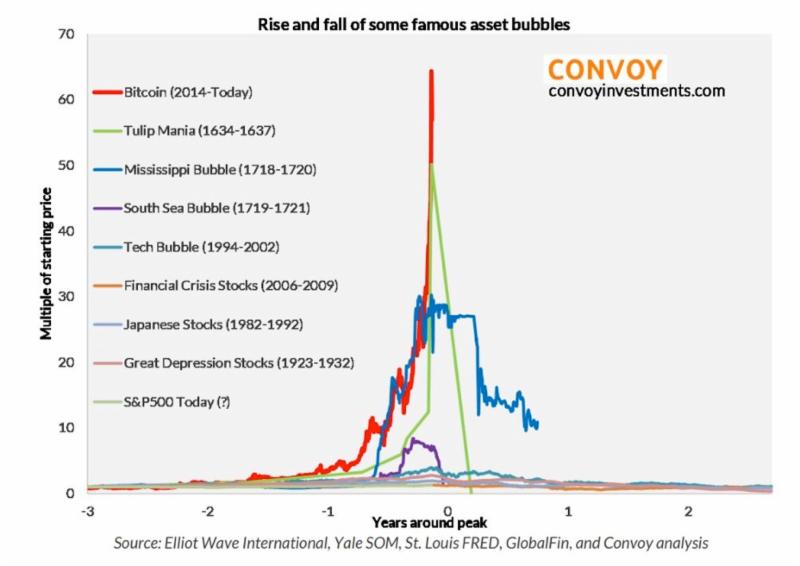
It is no coincidence that gold ended the year on a strong note, above $1,300, while Bitcoin began to show signs of getting wobbly after its spectacular rise in 2017. (Gold is an anti-bubble, but more on that in the second thought below.) It has now been confirmed (as zerohedge.com shows the bubble in the chart below) that Bitcoin is now the biggest bubble in financial history after its meteoric rise last year. The tulip mania of the 17th century, when well-smelling plants rose to over 40 times their initial value, was the previous title holder. Financial bubbles (including the dot-com boom of the 1990s) share not only a rapid ascent, but an equally rapid collapse (which of course bitcoin fans hope will not occur for the cryptocurrency). But bitcoin, along with other crypto-currencies, has a unique attribute among bubbles. When drkoop.com, one of the crash and burned dot-coms, collapsed at least owners had some assets like the office furniture, cool coffee cups and koopy t-shirts. Tulipsters had some nice flowers for the table. But if and when bitcoin--an asset with zero intrinsic worth--joins the other bubbles in collapse, what will be the residual value? A screenshot? Only if you don't forget your bitcoin password.
2. The "Everything Bubble" and how it relates to gold.
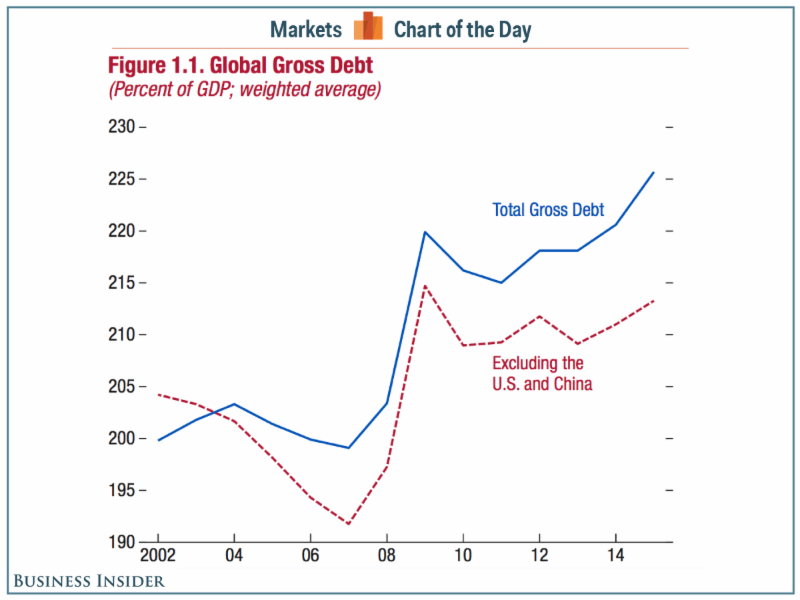
Every adult reading this has seen three financial bubbles in their lifetimes: the dot-com stock bubble of the 1990s, the housing bubble of the 2000s and now what is being regarded as the "everything bubble"--what we are living through today. Stocks are at the most expensive level in financial history since the 1929 and dot-com peaks. Bonds around the world are by far at their highest and real estate values are at extremes around the world. Global government debt of $152 trillion is at the highest level relative to GDP in world history, as the IMF has reported.
What happens next is anybody's guess, but what does this mean for gold?
When the dot-com bubble was bursting, gold was trading near $250 and rose six-fold over the next 11 years. When the housing bubble popped and the global stock market crashed in 2008, the world's largest bank, Royal Bank of Scotland, and AIG, the largest insurance company, collapsed into insolvency. All of
this caused gold to rise 5% that year. Thousands of years of financial history don't lie: when bubble dreams pop and people come back to financial earth, they buy gold. What is interesting about today's everything bubble is that even with the skyrocketing stock market boom, gold was up 12% in 2017. Perhaps we shouldn't be surprised: investors have seen this movie before.
3. What the Bond Market is saying about the tax cut.