Following the death of Alexander the Great in 323 B.C., his empire was immediately thrust into great turmoil. Many of his most trusted generals were battling for control, and eventually the empire was divided into three main divisions comprised of Egypt, Asia Minor, and Macedonia.
Over the next 200 years, the Roman Empire gained power and began to divide and conquer Greece, piece by piece. They struggled for many years to overcome a section of the empire comprised of the lands south of the Black Sea, referred to as Pontus.
|
|
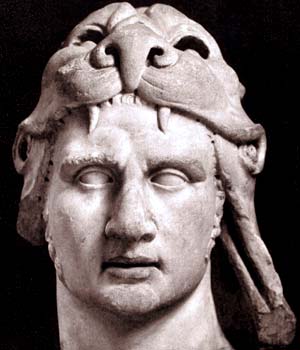
| Pictured is a bust of Mithridates VI, known as Mithridates the Great. |
Mithridatic Wars
There were three major wars between Rome and the kingdom of Pontus ranging in time from 88 - 63 B.C. They were referred to as the Mithridatic Wars, in honor of Mithridates VI, the battle-hardened King of Pontus from 120-63 B.C. The Mithridatic Wars ended around 63 B.C. when Roman armies were finally able to conquer the Kingdom of Pontus.
Gold Coinage of Mithridates VI
These intricate coins were issued in honor of and thought to depict a portrait of Alexander the Great, and show the ruler with a jeweled crown and a horn of Ammon, resembling a ram's horn. On the reverse is Athena, the goddess of war, seated on a throne holding Nike, the goddess of Victory, and resting her arm on a shield. Many other monograms and symbols can be found around her.
Until now, we have never been able to acquire more than one of these 2,100 year old coins at a single time.
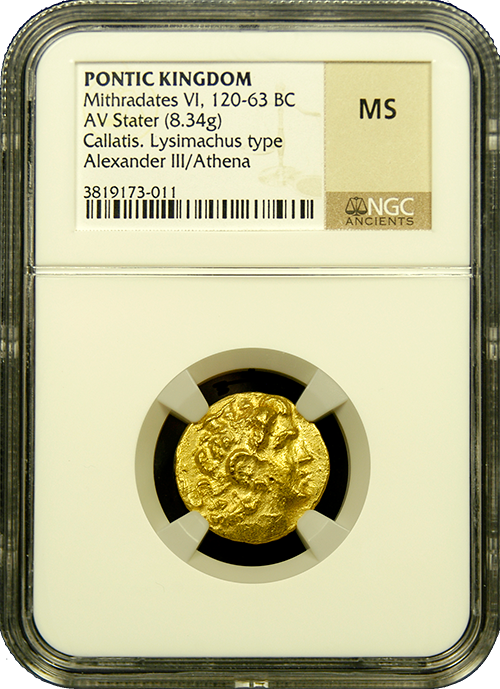 We just acquired a small group of Mithridates VI Gold Staters certified by NGC in various grades. Here are the details and quantities available:
We have seen numerous auction showings for inferior quality coins at much higher prices, so we have no hesitation offering them at these levels. It is highly unusual to be able to acquire 2,100 year old ancient gold coins for such remarkable price points and with so much quality and detail.